

Molecular Formula Of Coconut Oil
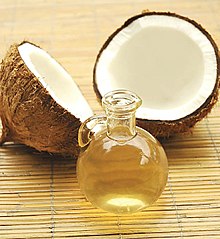
A cracked coconut and a canteen of coconut oil
Coconut oil (or coconut butter) is an edible oil derived from the wick, meat, and milk of the coconut palm fruit.[1] Coconut oil is a white solid fatty; in warmer climates during the summer months it is a clear thin liquid oil, melting at warmer room temperatures of around 25 °C (78 °F). Unrefined varieties have a distinct kokosnoot aroma.[2] Information technology is used as a food oil, and in industrial applications for cosmetics and detergent production.[1] [two] Due to its high levels of saturated fat, numerous health regime recommend limiting its consumption equally a food.[ii] [3]
Production [edit]
Coconut oil can be extracted through a wet or dry out process.[1] More than just (simply possibly less effectively), oil can be produced by heating the meat via boiling h2o, the sun or a tedious fire.[4]
Moisture process [edit]
The all-wet process uses kokosnoot milk extracted from raw coconut rather than dried copra. The proteins in the kokosnoot milk create an emulsion of oil and water.[5] The more problematic step is breaking up the emulsion to recover the oil. This used to be washed by prolonged humid, but this produces a discolored oil and is not economic. Modernistic techniques use centrifuges and pre-treatments including common cold, estrus, acids, salts, enzymes, electrolysis, shock waves, steam distillation, or some combination thereof. Despite numerous variations and technologies, wet processing is less feasible than dry out processing due to a ten–15% lower yield, even taking into account the losses due to spoilage and pests with dry processing. Wet processes likewise require investment of equipment and free energy, incurring high upper-case letter and operating costs.[6]
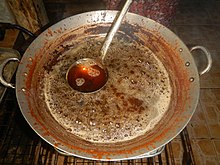
Traditional coconut oil ( lana ) extraction straight from kokosnoot milk in the Philippines. The process too produces latik (coconut curds), used as a garnishing in Filipino desserts.
Proper harvesting of the coconut (the age of a coconut can be ii to twenty months when picked) makes a significant deviation in the efficacy of the oil-making process. Copra made from immature nuts is more difficult to piece of work with and produces an inferior product with lower yields.[vii]
Conventional kokosnoot oil processors utilise hexane as a solvent to extract up to 10% more than oil than produced with just rotary mills and expellers. They then refine the oil to remove certain complimentary fatty acids to reduce susceptibility to rancidification. Other processes to increment shelf life include using copra with a wet content below 6%, keeping the moisture content of the oil below 0.2%, heating the oil to 130–150 °C (266–302 °F) and calculation common salt or citric acid.[eight]
Virgin coconut oil (VCO) can be produced from fresh coconut milk, meat, or residue. Producing information technology from the fresh meat involves either wet-milling or drying the residue, and using a screw press to extract the oil. VCO can also be extracted from fresh meat by grating and drying it to a moisture content of 10–12%, then using a manual printing to extract the oil. Producing information technology from coconut milk involves grating the coconut and mixing it with h2o, and then squeezing out the oil. The milk tin can also be fermented for 36–48 hours, the oil removed, and the cream heated to remove any remaining oil. A third option involves using a centrifuge to separate the oil from the other liquids. Coconut oil tin too be extracted from the dry residuum left over from the production of coconut milk.[8]
A thou mature coconuts weighing approximately 1,440 kilograms (3,170 pounds)[ description needed ] yield around 170 kg (370 lb) of copra from which around 70 litres (15 imp gal) of coconut oil tin can exist extracted.[9]
Dry process [edit]

Traditional manner of making coconut oil using an ox-powered mill in Republic of seychelles
Dry processing requires that the meat exist extracted from the shell and stale using burn, sunlight, or kilns to create copra.[ten] The copra is pressed or dissolved with solvents, producing the coconut oil and a high-protein, high-fiber brew. The mash is of poor quality for human consumption and is instead fed to ruminants; there is no process to extract protein from the mash.
Refined oil [edit]
Refined, bleached, and deodorized (RBD) oil is usually made from copra and dried coconut kernel, which is pressed in a heated hydraulic press to excerpt the oil. This yields practically all the oil present, amounting to more than sixty% of the dry weight of the coconut. This crude coconut oil is not suitable for consumption because it contains contaminants and must be refined with farther heating and filtering.[eleven]
Another method for extraction of coconut oil involves the enzymatic activity of alpha-amylase, polygalacturonases, and proteases on diluted coconut paste.[12]
Unlike virgin coconut oil, refined coconut oil has no kokosnoot gustatory modality or odor. RBD oil is used for dwelling house cooking, commercial food processing, and corrective, industrial, and pharmaceutical purposes.
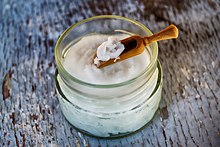
Kokosnoot oil on a wooden spoon
Hydrogenation [edit]
RBD coconut oil can be candy further into partially or fully hydrogenated oil to increase its melting point. Since virgin and RBD coconut oils melt at 24 °C (76 °F), foods containing kokosnoot oil tend to melt in warm climates. A higher melting point is desirable in these warm climates, then the oil is hydrogenated. The melting point of hydrogenated coconut oil is 36–40 °C (97–104 °F).
In the procedure of hydrogenation, unsaturated fats (monounsaturated and polyunsaturated fatty acids) are combined with hydrogen in a catalytic process to make them more than saturated. Coconut oil contains only half dozen% monounsaturated and 2% polyunsaturated fatty acids. In the partial hydrogenation process, some of these are transformed into trans fatty acids.[13]
Fractionation [edit]
Fractionated kokosnoot oil provides fractions of the whole oil then that its dissimilar fatty acids can exist separated for specific uses. Lauric acid, a 12-carbon chain fatty acid, is often removed because of its high value for industrial and medical purposes.[14] The fractionation of coconut oil can also be used to isolate caprylic acid and capric acid, which are medium-concatenation triglycerides, as these are used for medical applications, special diets and cosmetics, sometimes likewise being used as a carrier oil for fragrances.[xv]
| Coconut oil product – 2018 | |
|---|---|
| Land | (millions of tonnes) |
 Philippines Philippines | i.3 |
 Indonesia Indonesia | 0.9 |
 Republic of india Republic of india | 0.3 |
 Vietnam Vietnam | 0.2 |
 United mexican states United mexican states | 0.1 |
| World | 3.3 |
| Source: FAOSTAT of the United nations[16] | |
Standards [edit]
The Earth Wellness Arrangement's Codex Alimentarius guidelines on food, nutrient product, and food safety, published by the Food and Agronomics Organisation, includes standards for commercial partners who produce coconut oil for human consumption.[17]
The Asian and Pacific Coconut Customs (APCC), whose 18 members produce about 90 per cent of the coconut sold commercially,[18] has published its standards for virgin kokosnoot oil (VCO), defining virgin coconut oil equally obtained from fresh, mature coconut kernels through ways that practice not "atomic number 82 to alteration of the oil."[19]
In 2018, world production of coconut oil was 3.3 meg tonnes, led by the Philippines and Indonesia accounting together for 67% of the earth full.[16]
Limerick and comparison [edit]
Coconut oil contains only trace amounts of free fat acids (most 0.03% by mass).[xx] Nearly of the fatty acids are present in the course of esters. In the following content, the expressions "fatty acids" and "acid" below refer to esters rather than carboxylic acids.
The gauge concentration of fatty acids in coconut oil (midpoint of range in source):
The following table provides data almost the composition of kokosnoot oil and how it compares with other vegetable oils.
| Type | Processing treatment[23] | Saturated fat acids | Monounsaturated fatty acids | Polyunsaturated fat acids | Fume signal | ||||
|---|---|---|---|---|---|---|---|---|---|
| Total[21] | Oleic acid (ω-ix) | Full[21] | α-Linolenic acid (ω-3) | Linoleic acid (ω-half dozen) | ω-6:3 ratio | ||||
| Avocado[24] | xi.6 | seventy.6 | 52–66[25] | thirteen.five | 1 | 12.5 | 12.5:ane | 250 °C (482 °F)[26] | |
| Brazil nut[27] | 24.eight | 32.7 | 31.3 | 42.0 | 0.1 | 41.9 | 419:one | 208 °C (406 °F)[28] | |
| Canola[29] | 7.4 | 63.three | 61.8 | 28.1 | 9.1 | xviii.6 | 2:1 | 238 °C (460 °F)[28] | |
| Kokosnoot[30] | 82.5 | six.three | 6 | 1.7 | 175 °C (347 °F)[28] | ||||
| Corn[31] | 12.nine | 27.six | 27.iii | 54.7 | 1 | 58 | 58:1 | 232 °C (450 °F)[32] | |
| Cottonseed[33] | 25.ix | 17.eight | xix | 51.9 | ane | 54 | 54:1 | 216 °C (420 °F)[32] | |
| Flaxseed/linseed[34] | 9.0 | 18.4 | 18 | 67.8 | 53 | 13 | 0.2:ane | 107 °C (225 °F) | |
| Grape seed | ten.5 | 14.3 | xiv.3 | 74.7 | – | 74.vii | very loftier | 216 °C (421 °F)[35] | |
| Hemp seed[36] | 7.0 | 9.0 | ix.0 | 82.0 | 22.0 | 54.0 | two.5:1 | 166 °C (330 °F)[37] | |
| Olive[38] | thirteen.8 | 73.0 | 71.three | 10.five | 0.seven | nine.eight | xiv:1 | 193 °C (380 °F)[28] | |
| Palm[39] | 49.iii | 37.0 | twoscore | 9.3 | 0.2 | 9.1 | 45.5:1 | 235 °C (455 °F) | |
| Peanut[40] | 16.2 | 57.1 | 55.iv | 19.nine | 0.318 | 19.6 | 61.six:1 | 232 °C (450 °F)[32] | |
| Rice bran oil | 25 | 38.4 | ii.2 | 34.4[41] | 15.6 | 232 °C (450 °F)[42] | |||
| Loftier-oleic safflower oil[43] | 7.5 | 75.2 | 75.2 | 12.viii | 0 | 12.viii | very high | 212 °C (414 °F)[28] | |
| Sesame[44] | ? | xiv.2 | 39.7 | 39.3 | 41.7 | 0.3 | 41.3 | 138:1 | |
| Soybean[45] | partially hydrogenated | 14.9 | 43.0 | 42.5 | 37.half-dozen | ii.6 | 34.ix | 13.iv:1 | |
| Soybean[46] | fifteen.6 | 22.8 | 22.6 | 57.7 | vii | 51 | 7.three:1 | 238 °C (460 °F)[32] | |
| Walnut oil[47] | unrefined | ix.1 | 22.viii | 22.two | 63.3 | ten.four | 52.ix | five:i | 160 °C (320 °F)[48] |
| Sunflower[49] | viii.99 | 63.iv | 62.9 | xx.seven | 0.xvi | 20.v | 128:ane | 227 °C (440 °F)[32] | |
| Cottonseed[50] | hydrogenated | 93.half dozen | 1.5 | 0.6 | 0.2 | 0.3 | ane.5:1 | ||
| Palm[51] | hydrogenated | 88.2 | 5.seven | 0 | |||||
| The nutritional values are expressed as percent (%) past mass of total fatty. | |||||||||
Health concerns [edit]
Many health organizations suggest against the consumption of coconut oil owing to its high levels of saturated fatty,[3] including the United states of america Food and Drug Administration,[52] World Health Organization,[53] the United States Department of Health and Human Services,[54] American Dietetic Association,[55] American Center Clan,[56] British National Health Service,[57] British Nutrition Foundation,[58] [59] and Dietitians of Canada.[lx]
Marketing of coconut oil has created the inaccurate conventionalities that it is a "healthy food".[61] Instead, studies take found that coconut oil consumption has health effects similar to those of other unhealthy fats, including butter, beef fat, and palm oil.[iii] Kokosnoot oil contains a high amount of lauric acid, a saturated fat that raises full claret cholesterol levels by increasing the amounts of both loftier-density lipoprotein (HDL) cholesterol and low-density lipoprotein (LDL) cholesterol.[3] [62] [63] Although lauric acrid consumption may create a more favorable total blood cholesterol contour, this does non exclude the possibility that persistent consumption of coconut oil may actually increment the risk of cardiovascular diseases through other mechanisms,[62] peculiarly via the marked increment in total blood cholesterol induced by lauric acid.[63] [64] Because the majority of saturated fat in coconut oil is lauric acid,[63] [64] coconut oil may be preferred over partially hydrogenated vegetable oil when solid fats are used in the diet.[65]
Clinical research [edit]
A 2017 review of clinical enquiry by experts associated with the American Heart Association recommended against consumption of kokosnoot oil due to its propensity for increasing blood levels of LDL as a risk gene for cardiovascular diseases.[3]
A 2020 systematic review and meta-assay of clinical trials on whether chronic consumption of kokosnoot oil might affect run a risk factors for cardiovascular diseases found that low-density lipoprotein (LDL) cholestrol (but likewise loftier-density lipoprotein (HDL)) concentrations were elevated compared with nontropical vegetable oils. The review stated that "coconut oil should not exist viewed as healthy oil for cardiovascular disease take chances reduction, and limiting kokosnoot oil consumption because of its high saturated fat content is warranted."[62]
Uses [edit]
| Nutritional value per 100 grand | |
|---|---|
| Free energy | 3,730 kJ (890 kcal) |
| Fatty | 99 g |
| Saturated | 82.5 g |
| Monounsaturated | half dozen.iii g |
| Polyunsaturated | 1.vii g |
| Vitamins | Quantity %DV † |
| Vitamin E | 20% iii mg |
| Vitamin K | 1% 0.6 μg |
| Minerals | Quantity %DV † |
| Iron | 0% 0.05 mg |
| Other constituents | Quantity |
| phytosterols | 86 mg |
| Full link to USDA National Nutrient Database | |
| |
| †Percentages are roughly approximated using Usa recommendations for adults. Source: USDA FoodData Central | |
Diet and fat composition [edit]
Coconut oil is 99% fatty, composed mainly of saturated fats (82% of total; table). In a 100 gram reference amount, kokosnoot oil supplies 890 calories. One-half of the saturated fat content of coconut oil is lauric acid (41.8 grams per 100 grams of total composition), while other meaning saturated fats are myristic acid (xvi.7 g), palmitic acid (8.6 g), and caprylic acid (6.8 chiliad).[66] Monounsaturated fats are 6% of total composition, and polyunsaturated fats are 2% (table). Coconut oil contains phytosterols, whereas there are no micronutrients in significant content (tabular array).
In nutrient [edit]
Kokosnoot oil has a long history in Asia, particularly in tropical regions where the plant is abundant, where information technology has been used for cooking. Information technology is the oil of choice in Sri Lankan cuisine, where it is used for sautéing and frying, in both savoury and sugariness dishes. It also plays a prominent role in the cuisines of Thailand and Kerala.
As an oil relatively recently introduced to Western countries, coconut oil is normally used in baked goods, pastries, and sautés, having a nut-like quality with some sugariness.[67] It is sometimes used by picture palace chains to pop popcorn.
Other culinary uses include replacing solid fats produced through hydrogenation in baked and confectionery goods.[65] Hydrogenated or partially hydrogenated coconut oil is oft used in non-dairy creamers and snack foods. In frying, the smoke point of kokosnoot oil is 177 °C (351 °F).
Industry [edit]
Coconut oil has been tested for use as a feedstock for biodiesel to utilize as a diesel fuel engine fuel. In this manner, information technology tin can be applied to power generators and transport using diesel fuel engines. Since straight coconut oil has a high gelling temperature (22–25 °C), a high viscosity, and a minimum combustion bedroom temperature of 500 °C (932 °F) (to avert polymerization of the fuel), coconut oil typically is transesterified to make biodiesel. Use of B100 (100% biodiesel) is possible simply in temperate climates, as the gel point is approximately 10 °C (50 °F). The oil must meet the Weihenstephan standard[68] [ better source needed ] to employ pure vegetable oil every bit a fuel. Moderate to astringent damage from carbonisation and clogging would occur in an unmodified engine.


The Philippines, Vanuatu, Samoa, and several other tropical island countries employ coconut oil as an alternative fuel source to run automobiles, trucks, and buses, and to ability generators.[69] [ improve source needed ] Biodiesel fuel derived from kokosnoot oil is currently used every bit a fuel for transport in the Philippines.[70] [71] Further research into the potential of kokosnoot oil as a fuel for electricity generation is being carried out in the islands of the Pacific, although to date it appears that it is not useful equally a fuel source due to the cost of labour and supply constraints.[72]
Kokosnoot oil has been tested for use as an engine lubricant[73] and as a transformer oil.[74] Kokosnoot oil (and derivatives, such every bit coconut fat acid) are used equally raw materials in the manufacture of surfactants such as cocamidopropyl betaine, cocamide MEA, and cocamide DEA.
Acids derived from kokosnoot oil can exist used as herbicides.[75] Handling with catalytic lipase has reportedly given coconut oil antimicrobial characteristics.[76] Before the appearance of electric lighting, coconut oil was the primary oil used for illumination in India and was exported every bit cochin oil.[77]
Soap [edit]
Coconut oil is an of import base ingredient for the manufacture of soap. Soap made with coconut oil tends to be difficult, though it retains more water than soap made with other oils and thus increases manufacturer yields. Information technology is more soluble in hard water and salt water than other soaps allowing it to soap more hands.[78]
Other uses [edit]
The oil can exist used to treat dryness and sores from saltwater and sunburn. It tin be used for burning in a torch or dripped into fire to create insect-repelling smoke. It also protects metal from corrosion.[4]
See also [edit]
- KERAFED
- Saturated fat and cardiovascular affliction
References [edit]
- ^ a b c "Kokosnoot oil". Transport Information Service, German Insurance Association, Berlin. 2015.
- ^ a b c "Coconut Oil". The Nutrition Source, Harvard T.H. Chan School of Public Health, Boston. 2021.
- ^ a b c d e Sacks, Frank M.; Lichtenstein, Alice H.; Wu, Jason H.Y.; Appel, Lawrence J.; Creager, Marking A.; Kris-Etherton, Penny M.; Miller, Michael; Rimm, Eric B.; Rudel, Lawrence L.; Robinson, Jennifer G.; Stone, Neil J.; Van Horn, Linda V. (2017). "Dietary Fats and Cardiovascular Disease: A Presidential Informational from the American Heart Clan" (PDF). Circulation. 136 (3): e1–e23. doi:10.1161/CIR.0000000000000510. PMID 28620111. S2CID 367602.
Media summary: "Coconut oil 'every bit unhealthy equally beef fat and butter'". BBC News. June 16, 2017. Retrieved June 18, 2017. - ^ a b The Complete Guide to Edible Wild Plants. U.s.a. Department of the Army. New York: Skyhorse Publishing. 2009. p. 44. ISBN978-1-60239-692-0. OCLC 277203364.
{{cite volume}}: CS1 maint: others (link) - ^ Umesh Patil, Soottawat Benjakul (July xiii, 2018). "Coconut Milk and Coconut Oil: Their Manufacture Associated with Poly peptide Functionality". Curtailed Reviews & Hypotheses in Food Science. 83 (eight): 2019–2027. doi:10.1111/1750-3841.14223. PMID 30004125. S2CID 51617929.
- ^ Grimwood et al., 1975, pp. 193–210.
- ^ Grimwood et al., 1975, p. 29.
- ^ a b Kurian; Peter KV (2007). Commercial Crops Technology: Vol.08. Horticulture Scientific discipline Series. New India Publishing. pp. 202–206. ISBN978-8189422523.
- ^ Bourke, RM; Harwood T (2009). Nutrient and Agriculture in Papua New Republic of guinea. Australian National University. p. 327. ISBN978-1921536601.
- ^ Grimwood, Be; Ashman F; Dendy DAV; Jarman CG; Piddling ECS; Timmins WH (1975). Kokosnoot Palm Products – Their processing in developing countries. Rome: FAO. pp. 49–56. ISBN978-9251008539.
- ^ Foale, K. (2003). "The Coconut Odyssey: The Bounteous Possibilities of the Tree of Life" (PDF). Canberra: Australian Center for International Agricultural Research. pp. 115–116. Archived from the original (PDF) on 2017-07-21. Retrieved 2011-02-06 .
- ^ McGlone OC, Canales A, Carter JV (1986). "Coconut oil extraction by a new enzymatic process". J Food Sci. 51 (3): 695–697. doi:ten.1111/j.1365-2621.1986.tb13914.x.
- ^ Foster, R., Williamson, C.S. and Lunn, J. (2009). "Conference Newspaper: Culinary Oils And Their Wellness Furnishings". Nutrition Bulletin. 34 (one): 4–47. doi:10.1111/j.1467-3010.2008.01738.x.
{{cite periodical}}: CS1 maint: multiple names: authors list (link) - ^ Gervajio, One thousand. C. (2005). "Fat Acids and Derivatives from Coconut Oil". Bailey's Industrial Oil and Fat Products. doi:10.1002/047167849X.bio039. ISBN978-0471678496. S2CID 98315975.
- ^ Emil Raymond Riegel; James Albert Kent (2003). Riegel's Handbook of Industrial Chemistry. Springer. pp. 1100–1117. ISBN978-0306474118 . Retrieved twenty Oct 2012.
- ^ a b "Coconut oil production, 2018; Crops/Regions/World list/Production Quantity; unofficial data (choice lists)". United nations Nutrient and Agriculture Organization, Corporate Statistical Database (FAOSTAT). 2020. Retrieved eight April 2021.
- ^ "Codex Standard for Named Vegetable Oils (Codex Stan 210-1999, Revision 3)" (PDF). Codex Alimentarius. Food and Agriculture Organization. 2009. Retrieved 2011-08-09 .
- ^ "About us". Asian and Pacific Coconut Community. Archived from the original on 2011-08-29. Retrieved 2011-08-09 .
- ^ "APCC Standards for Virgin Coconut Oil" (PDF). Jakarta, Indonesia: Asian and Pacific Coconut Community. 2003. Archived from the original (PDF) on 2011-08-12. Retrieved 2011-08-09 .
- ^ Kratzeisen, M. (2010). "Influence of costless fat acid content of coconut oil on deposit and operation of plant oil pressure stoves". Fuel. 89 (7): 1583–1589. doi:10.1016/j.fuel.2009.08.038. Retrieved 30 April 2021.
- ^ a b c "United states National Nutrient Database, Release 28". Usa Section of Agriculture. May 2016. All values in this tabular array are from this database unless otherwise cited.
- ^ "Fats and fatty acids contents per 100 g (click for "more than details"). Example: Avocado oil (user can search for other oils)". Nutritiondata.com, Conde Nast for the USDA National Nutrient Database, Standard Release 21. 2014. Retrieved seven September 2017. Values from Nutritiondata.com (SR 21) may need to be reconciled with most recent release from the USDA SR 28 as of Sept 2017.
- ^ "USDA Specifications for Vegetable Oil Margarine Effective August 28, 1996" (PDF).
- ^ "Avocado oil, fat composition, 100 g". US National Nutrient Database, Release 28, Usa Department of Agriculture. May 2016. Retrieved 6 September 2017.
- ^ Feramuz Ozdemir; Ayhan Topuz (May 2003). "Changes in dry out affair, oil content and fat acids composition of avocado during harvesting fourth dimension and mail service-harvesting ripening flow" (PDF). Elsevier. Retrieved 15 January 2020.
- ^ Marie Wong; Cecilia Requejo-Jackman; Allan Woolf (April 2010). "What is unrefined, extra virgin cold-pressed avocado oil?". Aocs.org. The American Oil Chemists' Guild. Retrieved 26 December 2019.
- ^ "Brazil nut oil, fat composition, 100 g". Us National Nutrient Database, Release 28, The states Department of Agriculture. May 2016. Retrieved 6 September 2017.
- ^ a b c d e Katragadda, H. R.; Fullana, A. S.; Sidhu, South.; Carbonell-Barrachina, Á. A. (2010). "Emissions of volatile aldehydes from heated cooking oils". Food Chemistry. 120: 59–65. doi:10.1016/j.foodchem.2009.09.070.
- ^ "Canola oil, fat limerick, 100 thou". US National Food Database, Release 28, United States Department of Agriculture. May 2016. Retrieved 6 September 2017.
- ^ "Kokosnoot oil, fat composition, 100 thousand". US National Nutrient Database, Release 28, United states of america Section of Agronomics. May 2016. Retrieved six September 2017.
- ^ "Corn oil, industrial and retail, all purpose salad or cooking, fat composition, 100 k". US National Food Database, Release 28, United States Department of Agriculture. May 2016. Retrieved 6 September 2017.
- ^ a b c d e Wolke, Robert L. (May 16, 2007). "Where There'south Smoke, There'due south a Fryer". The Washington Post . Retrieved March 5, 2011.
- ^ "Cottonseed oil, salad or cooking, fatty composition, 100 g". United states of america National Nutrient Database, Release 28, United states of america Department of Agriculture. May 2016. Retrieved 6 September 2017.
- ^ "Linseed/Flaxseed oil, cold pressed, fatty composition, 100 k". US National Food Database, Release 28, United States Department of Agriculture. May 2016. Retrieved 6 September 2017.
- ^ Garavaglia J, Markoski MM, Oliveira A, Marcadenti A (2016). "Grape Seed Oil Compounds: Biological and Chemical Actions for Health". Nutrition and Metabolic Insights. ix: 59–64. doi:10.4137/NMI.S32910. PMC4988453. PMID 27559299.
- ^ Callaway J, Schwab U, Harvima I, Halonen P, Mykkänen O, Hyvönen P, Järvinen T (April 2005). "Efficacy of dietary hempseed oil in patients with atopic dermatitis". The Journal of Dermatological Treatment. 16 (2): 87–94. doi:10.1080/09546630510035832. PMID 16019622. S2CID 18445488.
- ^ "Smoke points of oils" (PDF).
- ^ "Olive oil, salad or cooking, fatty composition, 100 g". US National Nutrient Database, Release 28, The states Department of Agriculture. May 2016. Retrieved half dozen September 2017.
- ^ "Palm oil, fat limerick, 100 grand". U.s. National Nutrient Database, Release 28, United States Section of Agriculture. May 2016. Retrieved 6 September 2017.
- ^ "FoodData Central". fdc.nal.usda.gov.
- ^ Orthoefer, F. T. (2005). "Chapter 10: Rice Bran Oil". In Shahidi, F. (ed.). Bailey'southward Industrial Oil and Fatty Products. Vol. 2 (6 ed.). John Wiley & Sons, Inc. p. 465. doi:x.1002/047167849X. ISBN978-0-471-38552-3.
- ^ "Rice bran oil". RITO Partnership. Retrieved 22 Jan 2021.
- ^ "Safflower oil, salad or cooking, loftier oleic, primary commerce, fat composition, 100 thousand". U.s. National Nutrient Database, Release 28, U.s. Section of Agronomics. May 2016. Retrieved 6 September 2017.
- ^ "Oil, sesame, salad or cooking". FoodData Central. fdc.nal.usda.gov.
- ^ "Soybean oil, salad or cooking, (partially hydrogenated), fat composition, 100 g". US National Nutrient Database, Release 28, Us Department of Agronomics. May 2016. Retrieved 6 September 2017.
- ^ "Soybean oil, salad or cooking, fatty composition, 100 1000". US National Nutrient Database, Release 28, United States Department of Agriculture. May 2016. Retrieved half dozen September 2017.
- ^ "Walnut oil, fat composition, 100 g". US National Nutrient Database, Usa Department of Agriculture.
- ^ "Smoke Point of Oils". Baseline of Health. Jonbarron.org.
- ^ "FoodData Fundamental". fdc.nal.usda.gov.
- ^ "Cottonseed oil, industrial, fully hydrogenated, fat composition, 100 g". U.s.a. National Nutrient Database, Release 28, United States Department of Agronomics. May 2016. Retrieved 6 September 2017.
- ^ "Palm oil, industrial, fully hydrogenated, filling fat, fat composition, 100 g". U.s.a. National Nutrient Database, Release 28, United states of america Department of Agriculture. May 2016. Retrieved 6 September 2017.
- ^ "Effectually the Block Nutrition Facts at a Glance: More on Nutrients to Get Less Of". Food and Drug Administration. 2012-09-05. Archived from the original on 2014-02-01. Retrieved 2014-01-25 .
- ^ "Avoiding Middle Attacks and Strokes" (PDF). World Health Organization. Retrieved 2011-04-06 .
- ^ "Dietary Guidelines for Americans 2010" (PDF). Department of Health and Man Services. Archived from the original (PDF) on 1 September 2016. Retrieved 17 March 2011.
- ^ "American Dietetic Clan and Dietitians of Canada Offer Up-to-Date Guidance on Dietary Fat". American Dietetic Association. Archived from the original on 2012-03-nineteen. Retrieved 2011-03-16 .
- ^ "Tropical Oils". American Middle Association. Archived from the original on 2011-06-02. Retrieved 2011-03-xvi .
- ^ "Lower your cholesterol". National Wellness Service. Retrieved 2011-03-16 .
- ^ Foster R, Williamson CS, Lunn J (2009). "Culinary oils and their wellness furnishings". Nutrition Message. 34: 4–47. doi:10.1111/j.1467-3010.2008.01738.10.
- ^ Lockyer S, Stanner Due south (2016). "Coconut oil – a nutty idea?". Nutrition Message. 41 (1): 42–54. doi:ten.1111/nbu.12188.
- ^ "Heart Healthy Eating: Cholesterol". Dietitians of Canada. 2010-09-01. Archived from the original on 2013-09-21. Retrieved 2013-07-05 .
- ^ Abbasi, J (eight April 2020). "Coconut Oil's Health Halo a Mirage, Clinical Trials Suggest". JAMA. 323 (16): 1540–1541. doi:x.1001/jama.2020.5186. PMID 32267505.
- ^ a b c Neelakantan, Nithya; Seah, Jowy Yi Hoong; van Dam, Rob M. (2020-03-10). "The effect of coconut oil consumption on cardiovascular adventure factors: A Systematic Review and Meta-Analysis of Clinical Trials". Apportionment. 141 (10): 803–814. doi:ten.1161/circulationaha.119.043052. ISSN 0009-7322. PMID 31928080. S2CID 210195904.
- ^ a b c Eyres, 50; Eyres, MF; Chisholm, A; Brown, RC (April 2016). "Kokosnoot oil consumption and cardiovascular risk factors in humans". Diet Reviews. 74 (4): 267–80. doi:10.1093/nutrit/nuw002. PMC4892314. PMID 26946252.
- ^ a b Mensink RP, Zock PL, Kester Advertising, Katan MB (May 2003). "Furnishings of dietary fatty acids and carbohydrates on the ratio of serum total to HDL cholesterol and on serum lipids and apolipoproteins: a meta-analysis of lx controlled trials" (PDF). Am J Clin Nutr. 77 (five): 1146–55. doi:ten.1093/ajcn/77.5.1146. PMID 12716665.
- ^ a b Tarrago-Trani, MT; Phillips, KM; Lemar, LE; Holden, JM (2006). "New and existing oils and fats used in products with reduced trans-fat acid content" (PDF). Journal of the American Dietetic Clan. 106 (6): 867–880. doi:10.1016/j.jada.2006.03.010. PMID 16720128.
- ^ "Coconut oil; Nutrient content per 100 one thousand". USDA National Food Database, Standard Release 28. May 2016. Retrieved 1 September 2017.
- ^ Clark, Yard (2011-03-01). "Once a Villain, Coconut Oil Charms the Health Nutrient World". The New York Times . Retrieved 2011-03-02 .
- ^ "Weihenstephan vegetable oil fuel standard (German Rapeseed Fuel Standard)". Retrieved 2011-08-09 .
- ^ "In Vanuatu, A Proving Ground for Coconut Oil As An Alternative Fuel". One Country. Retrieved 2011-08-09 .
- ^ "Kokosnoot fuel". The Earth. Public Radio International. Retrieved 2011-08-09 .
- ^ Watson, Todd (1 August 2013). "Kokosnoot biodiesel drives the Philippines". Inside Investor . Retrieved xi August 2013.
- ^ Koo, Sung Mo (July 6, 2018). "Coconut Oil : Spotlight Fades Away". Tridge . Retrieved July 6, 2018.
- ^ Romares-Sevilla, J (2008-01-17). "Davao-based firm sees expansion of bio-tech oil market". Sun.Star Superbalita Davao. Archived from the original on 2008-01-21. Retrieved 2008-07-14 .
- ^ DC, Abeysundara; Weerakoon, C; Lucas, JR; Gunatunga, KAI; Obadagee, KC (2001). "Coconut Oil As An Alternative To Transformer Oil" (PDF). ERU Symposium. Archived from the original (PDF) on 2015-09-23. Retrieved 2009-07-28 .
- ^ James, TK; Rahman A (2005). "Efficacy of several organic herbicides and glyphosate formulations under simulated rainfall" (PDF). New Zealand Plant Protection. 58: 157–163. doi:ten.30843/nzpp.2005.58.4322.
- ^ Haris, Halina Hezda (2012). "Evaluation of Efficacy and Safety of AVCO Acne Gel for Acne: An Open, Single Centric, Non Comparative Report for 8 Weeks". Asian Journal of Pharmaceutical and Clinical Research. iv.
- ^ Brady, GS; Clauser, HR; Vaccari, JA (2002). Materials Handbook – An encyclopedia for managers, technical professionals, purchasing and product managers, technicians, and supervisors (fifteen ed.). McGraw-Hill. pp. 250–251. ISBN978-0-07-136076-0.
- ^ Alsberg, CL; Taylor AE (1928). The Fats and Oils – A Full general Overview (Fats and Oils Studies No. 1) . Stanford Academy Printing. p. 86. ISBN978-0-8047-0330-7.
Further reading [edit]
- Adkins SW; Foale M; Samosir YMS, eds. (2006). Coconut revival – new possibilities for the 'tree of life'. Proceedings of the International Coconut Forum, 22–24 Nov 2005 (PDF). Cairns, Australia: ACIAR Proceedings. ISBN978-1863205153. Archived from the original (PDF) on xv April 2016. Retrieved 13 March 2011.
- Salunkhe, D.Thou., J.Chiliad. Chavan, R.N. Adsule, and Southward.S. Kadam. (1992). Earth Oilseeds: Chemistry, Applied science, and Utilization. Springer. ISBN 978-0442001124.
External links [edit]
-
 Media related to Coconut oil at Wikimedia Commons

Molecular Formula Of Coconut Oil,
Source: https://en.wikipedia.org/wiki/Coconut_oil
Posted by: stringerbearring.blogspot.com
0 Response to "Molecular Formula Of Coconut Oil"
Post a Comment